A craft that will not die
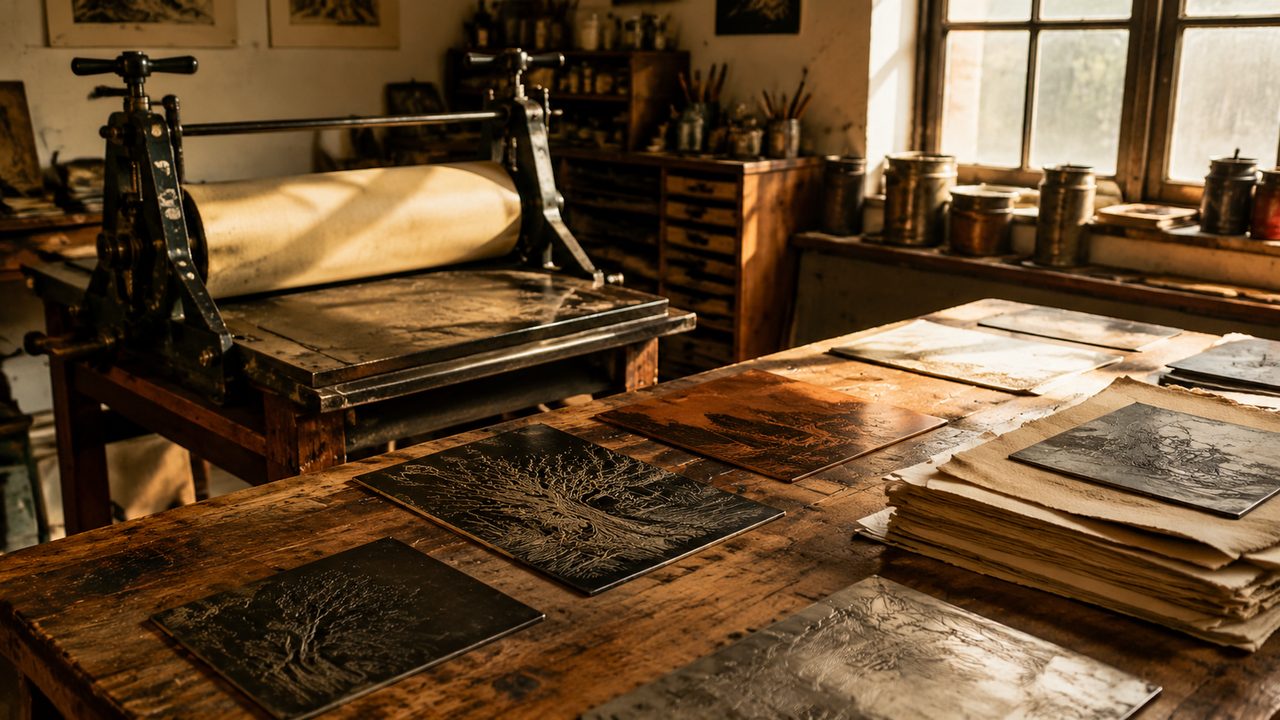
Printmaking is the oldest art form that still looks new: etching, screenprint, lithography and the newer risograph presses all trade on the same idea — an image made to be repeated, each copy slightly alive. London has kept the craft alive better than most cities, thanks to a network of co-operative studios, commercial presses and artist-run shops spread across the east and south of the city.
The distinction that matters for visitors is between the fine-art print — an editioned work, signed and numbered — and the poster. The workshops below make the first kind, and most of them welcome a curious audience at their open days. The fair and the workshop run on the same etiquette: prints are signed, numbered and sold as multiples, and a good print should look as alive on the wall as it does on the press.
East London Printmakers
East London Printmakers, on Corbridge Crescent in Bethnal Green, is a members' co-operative that has run since the late 1990s. Artists pay a monthly fee for access to the studio's etching presses, screen beds and printing tables, and the space doubles as a workshop for courses and an occasional gallery.
The studio holds regular open days and a print fair, where members' work is sold at prices that start well below gallery levels. It is the best place in London to see the full range of what a print studio actually does — and, if you book a course, to pull your own first print.
Thames-Side Print Studio in Greenwich
Across the river, Thames-Side Print Studio occupies a workshop building near the water in Greenwich, part of the old industrial riverfront that now hosts artists rather than industry. The studio is a co-operative with a strong tradition of etching and relief printing, and its members include some of the most accomplished printmakers in the city.
Like most co-operatives, it opens to the public mainly for courses, open days and its annual sale. The setting — a working studio a few minutes from the Cutty Sark — makes the visit worth the journey even before you look at the prints.
Print Club London and the DIY screenprint
Print Club London, in Dalston, took the craft in a different direction: public screen-printing. Its drop-in sessions let anyone pull a poster through the screens, and its editions programme has worked with artists and bands across the music and art worlds. The studio's energy is loud, fast and deliberately un-precious.
The club's public sessions cost around £40–60 depending on the format, and they are the easiest way in London to try the medium without joining a course. The resulting prints are your own — which is the point: printmaking is the one art form that still works as a participation sport.
Where to see the results
The easiest way to see what London's printmakers make is the two big fairs. The London Original Print Fair at Somerset House runs each spring, with dealers showing historical and contemporary prints, and the Woolwich Contemporary Print Fair, held every November, is free and dedicated to new work — the country's largest survey of contemporary printmaking.
The Royal Academy's Summer Exhibition also has a dedicated print room, where the best of the open submissions hang year after year. Between the fairs and the open days, there is a week of print in the calendar for every season.
Practical notes
Studio visits are mostly by appointment or at scheduled open days, so check each workshop's listings before travelling; the fairs need no such planning and are the friendliest way in. Prices range from a few pounds for a student print at a fair to several hundred for an editioned work by an established maker.
Bethnal Green, Greenwich and Dalston are all reachable by rail or Overground, and each workshop sits within walking distance of a gallery or market — the printmaker's London is also the visitor's London.