The queue is part of the building
The main entrance on Cromwell Road is where everyone lines up, and the queue is the first thing you should treat with suspicion: the same galleries are reachable through the Exhibition Road entrance on the west side of the building, which is quieter at almost every hour of the day. The museum is free, open daily from 10:00 to 17:50, and entry to the permanent galleries currently runs on free timed tickets booked online — booking one is the single best queue-dodge available.
The building itself was designed to be the first exhibit. Opened in 1881, it was the work of the architect Alfred Waterhouse, who covered the outside in terracotta because he wanted a building that would not blacken in London's coal smoke. It is the most deliberately beautiful scientific building in the country, and most visitors spend the whole visit without once looking up.
A cathedral built for science
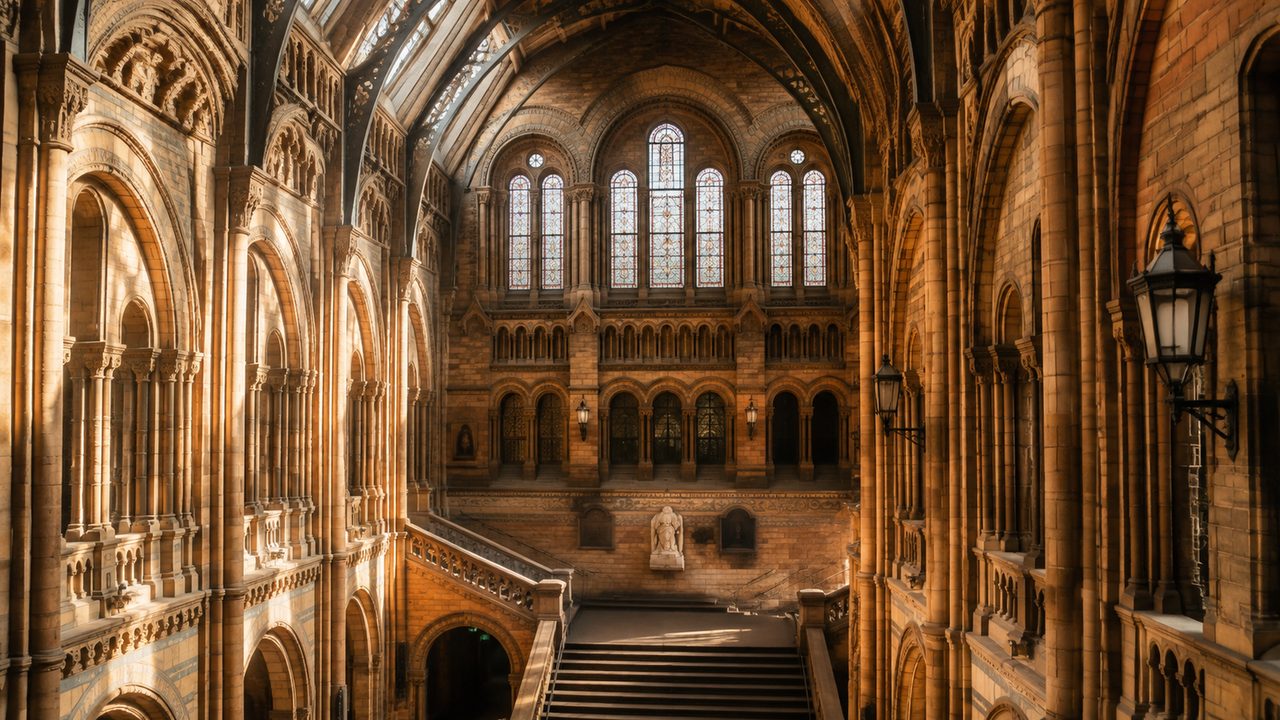
Waterhouse's design borrowed the style of Romanesque churches — round arches, sturdy columns, deep-set windows — so that the museum would feel like a temple rather than a factory. The point was rhetorical: science was the new religion, and the building was its shrine. The towers at the Cromwell Road end frame the entrance like a cathedral's twin spires, though they are chimneys and stairwells rather than bells.
The choice of terracotta mattered as much as the silhouette. The pale biscuit-coloured blocks were moulded with animals, plants and faces, so the building's skin itself carries a natural-history lesson.
The Hintze Hall and the whale
The central hall, renamed Hintze Hall, is the building's great set piece: a cathedral nave with a 30-metre blue whale skeleton suspended from the ceiling since 2017, replacing the famous Diplodocus cast that stood there for more than a century. The whale is the right decision — it forces your eye up, which is exactly where Waterhouse wanted it.
The hall's columns are carved with plant forms, and the balconies above the side aisles let you walk around the whale at eye level. Stand on the east balcony for the classic view: the whale, the staircase and the vaulted ceiling in one frame.
The menagerie in the stonework
The building's best jokes are outside. Carved monkeys hang from the window arches, squirrels climb the buttresses and a menagerie of birds and beasts runs across the facade, each one designed to be discovered on a second visit. The richest carving is around the main entrance and along the Exhibition Road side, where the ornament is densest.
Waterhouse's terracotta was made by the firm of Gibbs and Canning, who fired more than nine thousand individually modelled blocks. If you can only stop for one detail, find the carved owl above the central door.
The grand staircase and what sits above it
The staircase at the end of the Hintze Hall is the building's second great moment, with the first-floor balconies opening onto the halls of the mineral and earth galleries. The Darwin Centre's glass cocoon — a nine-storey white pod inside a concrete shell — is the modern counterpoint, and the walkway inside it is free with gallery entry.
From the upper balconies the whole logic of the building becomes clear: the public halls ring the central court, the research collections sit in the wings, and the architecture quietly tells you which is which.
Practical notes
Book the free timed ticket for the main galleries before you travel; the museum is free, but entry without a booking can mean a long wait. The Exhibition Road entrance is the quickest way in from South Kensington station, and the station itself is worth a detour — its tiled walls carry panels drawn from the museums' collections.
The Natural History Museum sits on Exhibition Road between the Science Museum and the V&A, which makes it possible — and punishing — to try all three in a day. Do one properly instead, and give the building an hour of your visit on its own.