Why one hour is the right amount
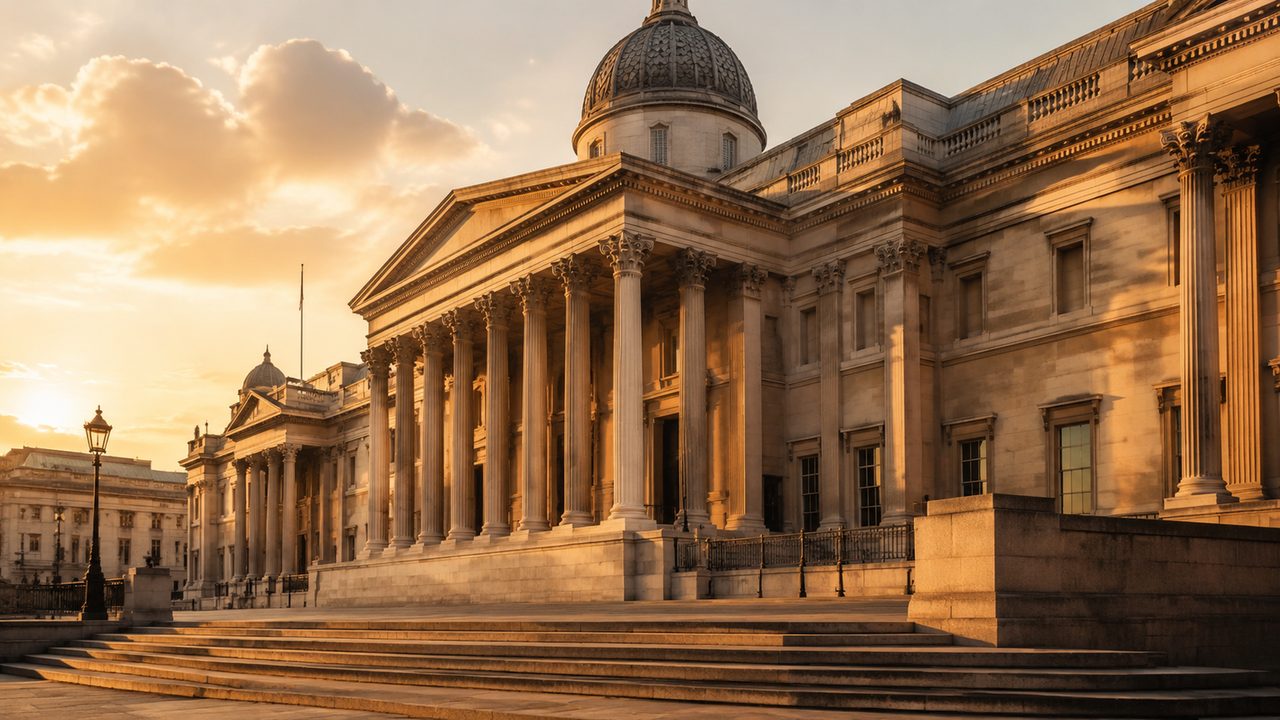
Most visitors spend two and a half hours at the National Gallery and remember about six paintings. The route below is designed to fix that ratio. It treats the gallery not as a place to be exhausted but as a building to be crossed once, in order, stopping only where the paintings earn it. The plan assumes the main entrance on Trafalgar Square, but the Sainsbury Wing door on the same side works just as well and is usually calmer. Either way you will be inside and past security in under ten minutes.
The ground rules are simple. Do not queue for a free audio guide if you only have sixty minutes. Do not take the lift to the top floor first. And do not read the wall text aloud — the labels are useful, but at one minute per painting they are a budget you cannot afford. The gallery is free, open daily from 10:00 to 18:00, with late opening until 21:00 on Fridays, and there is a free cloakroom if you arrive with a bag.
Start in the Sainsbury Wing
Begin with the early Renaissance, because it gives you the pleasure of watching painting get good. Van Eyck's Arnolfini Portrait, in the room just off the wing's main landing, is the one to stop at: a double portrait from 1434 with a convex mirror, a small dog and light doing things that are still remarkable five centuries later. The Sainsbury Wing's long central gallery holds a run of early Italian panels that rewards a slow walk rather than a sprint. Five minutes in here is enough, but spend them on the Van Eyck — it repays a closer look than most paintings ever get.
The central rooms: Raphael to Caravaggio
Cut through to the main building and give the central range ten minutes. This is the stretch most people skip on the way to the Impressionists, which is exactly why it works. Raphael's Ansidei Madonna, Titian's Bacchus and Ariadne and Caravaggio's Supper at Emmaus hang within a couple of rooms of one another, and together they tell a story of painting moving from calm certainty to theatrical light. Stand in front of the Caravaggio for two full minutes without looking at the label. The tablecloth does the work.
Ten minutes with the Impressionists
The Impressionist and Post-Impressionist rooms sit above the great staircase in the east wing, and they are the busiest galleries in the building outside school holidays. That is not a reason to skip them. Van Gogh's Sunflowers, Seurat's Bathers at Asnières and Monet's late water-lily canvases are all here, and the crowds politely shuffle around each picture in a slow circuit. The trick is not to join the queue around the Sunflowers. Stand at the back of the room, take in the whole wall, then move to the Seurat and the Monets, where the space is thinner. Ten minutes is plenty.
The Dutch room and the British end
Head west to the seventeenth-century Dutch rooms for Rembrandt's self-portraits and the pair of Vermeer interiors the gallery holds. The Vermeer room is small, quiet and often nearly empty by late afternoon — worth protecting from your schedule. Finish in the west wing with Turner's The Fighting Temeraire and Constable's The Hay Wain, hanging as friendly rivals, with the Temeraire's pale ghost of a ship pulling toward the exit exactly when you need it.
The exit plan
Walk out onto Trafalgar Square with your back to the gallery and you will have crossed roughly the entire history of European painting without once feeling rushed. If you have energy left, the National Portrait Gallery is across the square and equally free; if you do not, the café on the lower ground floor serves a passable coffee, and Friday nights stay open late enough for a second pass. Book nothing, queue for nothing, and leave the way you came in — the one-hour route works best when you treat it like a good walk, not a checklist.